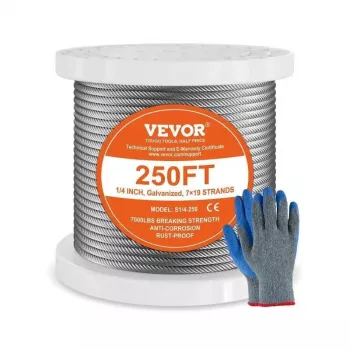
A 250-foot galvanized steel wire cable rope is a practical choice for outdoor tie-downs, utility tensioning, light rigging, and general-purpose securing where corrosion resistance and strength matter. The zinc coating helps slow rust in damp environments, while the steel strands provide low stretch and dependable load control when paired with the right fittings and safe installation practices.
Long wire rope runs are easiest when they’re continuous—fewer joints, fewer failure points, and more consistent tension across the span. A 250 ft spool is especially useful for projects that need a clean, uninterrupted line.
For any tensioned setup, keep in mind that cable stores energy. If something slips or an anchor fails, the line can snap back with serious force—so hardware choice and installation quality matter as much as the cable itself.
Two cables that look similar can behave very differently once tensioned, bent around a pulley, or exposed to weather. Confirm the basics before buying so the cable, fittings, and application all match.
| Item | What to confirm | Why it matters |
|---|---|---|
| Cable diameter | Matches clips/thimbles/turnbuckles | Prevents slippage and uneven clamping |
| Working load approach | Use a conservative safety factor for the task | Reduces risk from shock loads and wear |
| Bend radius | Pulley/sheave diameter is appropriate | Too-tight bends shorten cable life |
| Environment | Rain/salt/chemicals/abrasion exposure | Drives coating and maintenance needs |
| End termination | Correct number/type of clips or proper swage | A weak termination can fail before the cable |
Most real-world performance issues come from end terminations, anchor points, and sharp-edge contact—not from the middle of the cable. Build the system as a system.
If the line runs across a bracket or a post, add a barrier (chafe guard, smooth fairlead, or properly sized pulley/sheave). Abrasion can cut through galvanizing and accelerate broken wires over time.
For regulated lifting applications and wire rope sling practices, consult OSHA guidance such as OSHA 29 CFR 1910.184. For consistency when documenting load units and measurements, a reference like NIST Handbook 44 can be helpful.
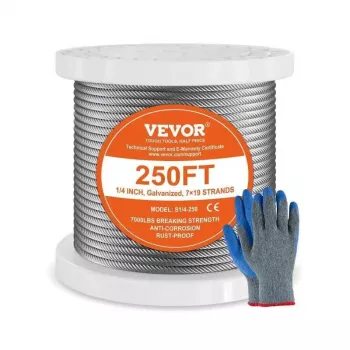
The 250 ft Galvanized Steel Wire Cable Rope is a long, galvanized steel cable option suited for outdoor utility runs, general securing, and tensioning setups requiring extended length. It’s especially useful when a single continuous line is preferred to minimize joints and simplify consistent tension across the span.
| Detail | Value |
|---|---|
| Length | 250 ft |
| Material/finish | Galvanized steel wire rope |
| Availability | In stock |
| Price | 75.01 USD |
Yes. The galvanized coating improves corrosion resistance for year-round outdoor use, but the cable still needs regular inspection, cleaning, and protection from abrasion—especially in salt air or splash zones where corrosion accelerates.
Use the clip manufacturer’s chart for your cable diameter, and follow their guidance for clip orientation, spacing, and torque. The correct installation details are as important as the number of clips.
Replace wire rope if you see kinks, birdcaging, multiple broken wires, severe rust or pitting, crushed/flattened sections, strand separation, or any slippage at terminations.











Leave a comment